
Landscapers Norwich
Block paving in Norwich for paths, patios and parking
Landscapers Norwich lays block paving across Norwich and Norfolk for paths, patios and parking areas, built on a compacted base and held by edge restraints so the blocks stay locked together.
Why block paving lasts when it is laid well
Block paving is made of small concrete or clay blocks laid tight together on a bed of sharp sand. Once they are compacted and the joints filled with fine sand, the blocks lock against each other and spread the load across the whole surface. That interlock is what lets a block paved area carry feet, bins, bikes and cars while still being easy to lift and relay in one spot if a pipe ever needs to be reached.
The interlock only works if the frame around it is solid. Landscapers Norwich sets a concrete-haunched edge course or kerb around every block paved area, so the blocks cannot creep outwards, and builds a compacted sub-base sized for the load it will carry. Laying patterns matter too: herringbone suits anything a car will turn on, while stretcher bond and basketweave patterns work well on paths and patios.
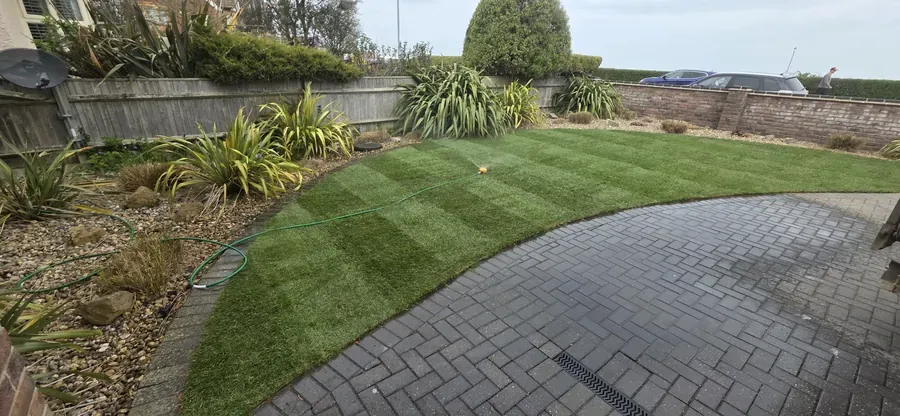
Block paving suits homeowners who want a hard-wearing, repairable surface that looks smart from the road, and gardens where paths, a patio and a parking space can be laid in one matching material. It also suits curved layouts, because the small blocks follow a curve more easily than large slabs.
What is included in our block paving work
Each quote lists what is in the price, from the dig to the final brush of sand.
- Survey and set-outLevels, falls, drainage points and the shape of the area marked out on the ground before any digging starts.
- Excavation and muck awayThe area dug to the depth its use needs, and the spoil taken off site.
- Sub-base and compactionCrushed stone sub-base laid and compacted with a plate compactor in layers.
- Edge restraintsKerbs or edging blocks bedded and haunched in concrete to hold the paving in place.
- Sand bed and layingA screeded bed of sharp sand, with blocks laid to your chosen pattern and cut neatly at the edges.
- Compaction and jointingThe surface compacted to lock the blocks, then kiln-dried sand brushed into the joints.
- Drainage detailsFalls set towards a lawn, bed or channel drain so water does not sit on the surface.
Before you book
Decisions to make before block paving
-
What it will carry
A path for feet needs a lighter base than an area a car parks on. Tell us if a car, a van or a skip lorry might ever drive on it, so the base is built for it from the start.
-
Colour and pattern
Block colours range from charcoal and grey to warm reds and brindles. Herringbone suits vehicle areas; simpler bonds suit paths. Look at blocks wet and dry, as the colour changes.
-
Borders and edging
A contrasting border frames the area and hides the cuts at the edge. It is worth deciding early, as it changes the setting out.
-
Covers and access points
Manhole and inspection covers can be fitted with recessed trays so the blocks continue over them. Let us know where yours are.
Good to know
Good to know about block paving
- Joint sand settles
- For the first few months the jointing sand settles down into the gaps. Topping it up with kiln-dried sand keeps the blocks locked and weeds down.
- Weeds come from the top
- Most weeds in block paving grow from seeds that land in the joints, not from below. Regular brushing and keeping the joints full is the best prevention.
- Efflorescence fades
- A white bloom can appear on new concrete blocks. It is salt coming to the surface, it is harmless, and it weathers away on its own.
- It can be lifted and relaid
- If a service pipe needs to be reached, a block paved area can be lifted and relaid in that spot, which is one of its practical advantages.
How it works
How block paving is laid
-
Visit and quote
We look at the area, the use and the drainage, and give you a free written quote.
-
Dig and base
The area is excavated, the sub-base laid and compacted, and the edge restraints set in concrete.
-
Screed and lay
A level sand bed is screeded, the blocks laid to pattern and the edges cut.
-
Lock and finish
The paving is compacted, jointed with kiln-dried sand, swept and left ready to use.
Is herringbone better than other patterns?
For areas cars drive and turn on, yes: herringbone resists the blocks shifting under tyres. For paths and patios, other bonds are perfectly strong and can look calmer.
How do I stop weeds growing in block paving?
Keep the joints full of kiln-dried sand and brush the surface regularly. A jointing sand that hardens after watering is another option on low-traffic areas.
Can block paving be laid on a curve?
Yes. Small blocks follow curves well, and the cut edges are hidden by an edging course laid around the curve.
Can you match new block paving to my existing drive?
Sometimes. Block ranges change and older paving weathers, so an exact match is not always possible. A contrasting border often joins old and new more neatly.
Is block paving permeable?
Standard block paving sheds water off its surface, so it needs a fall and somewhere for the water to go. Permeable block systems let water through the joints into a specially built base.
Other hard landscaping we do
- PatiosIndian sandstone, porcelain and natural stone patios, laid on a full mortar bed with the right fall.
- DrivewaysBlock paving, gravel and natural stone driveways, dug out and built up to carry a car for years.
- Garden paths and stepsPaths, steps and edging that link the house, the patio and the garden, set out so they are easy and safe underfoot.
Thinking about block paving?
Tell us what the area is for and roughly how big it is, and we will come and measure up for a free quote.